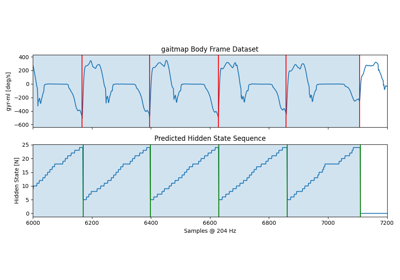
gaitmap.stride_segmentation.hmm.HmmStrideSegmentation#
- class gaitmap.stride_segmentation.hmm.HmmStrideSegmentation(model: ~gaitmap_mad.stride_segmentation.hmm._hmm_stride_segmentation.BaseSegmentationHmmT = cf(RothSegmentationHmm(algo_predict='viterbi', algo_train='baum-welch', data_columns=['raw__gyr_ml', 'gradient__gradient__gyr_ml'], feature_transform=RothHmmFeatureTransformer(axes=['gyr_ml'], features=['raw', 'gradient'], low_pass_filter=ButterworthFilter(cutoff_freq_hz=10, filter_type='lowpass', order=4), sampling_rate_feature_space_hz=51.2, standardization=True, window_size_s=0.2), initialization='labels', max_iterations=1, model=HiddenMarkovModel[name=segmentation_model](...), n_jobs=1, name='segmentation_model', stop_threshold=1e-09, stride_model=SimpleHmm(algo_train='baum-welch', architecture='left-right-strict', data_columns=['raw__gyr_ml', 'gradient__gradient__gyr_ml'], max_iterations=10, model=HiddenMarkovModel[name=stride_model-trained](...), n_gmm_components=6, n_jobs=1, n_states=20, name='stride_model', stop_threshold=1e-09, verbose=True), transition_model=SimpleHmm(algo_train='baum-welch', architecture='left-right-loose', data_columns=['raw__gyr_ml', 'gradient__gradient__gyr_ml'], max_iterations=10, model=HiddenMarkovModel[name=transition_model-trained](...), n_gmm_components=3, n_jobs=1, n_states=5, name='transition_model', stop_threshold=1e-09, verbose=True), verbose=True)), *, snap_to_min_win_ms: float | None = 100, snap_to_min_axis: str = 'gyr_ml')[source]#
Segment strides using a pre-trained Hidden Markov Model.
Note
This algorithm is only available via the
gaitmap_madpackage and distributed under a AGPL3 licence. To use it, you need to explicitly install thegaitmap_madpackage. Learn more about that here.This method does not care about the implementation details of the HMM used. As long as it is a valid subclass of BaseSegmentationHmm, it can be used here. On top of the segmentation, this class implements a postprocessing step that snaps the minima in the raw signals and contains convenience methods that ensure that outputs conform to the expected gaitmap formats.
Note, that this class only supports prediction. To train your own HMM, use the
self_optimizemethod on the model that you were planning to use here.This is based on the work of Roth et al. 2021 [1] and the implementation is using done with
pomegranate[2].- Parameters:
- model
The HMM class need a valid pre-trained model to segment strides
- snap_to_min_win_ms
The size of the window in seconds used to search local minima during the post processing of the stride borders. If this is set to None, this postprocessing step is skipped. Refer to the Notes section for more details.
- snap_to_min_axis
The axis of the data used to search for minima during the processing of the stride borders. The axis label must match one of the axis label in the data. Refer to the Notes section for more details.
- Other Parameters:
- data
The data passed to the
segmentmethod.- sampling_rate_hz
The sampling rate of the data
- Attributes:
- matches_start_end_2D array of shape (n_detected_strides x 2) or dictionary with such values
The start (column 1) and end (column 2) of each detected stride.
stride_list_A stride list or dictionary with such valuesReturn start and end of each match as pd.DataFrame.
matches_start_end_original_2D array of shape (n_detected_strides x 2) or dictionary with such valuesReturn the starts and end directly from the hidden state sequence.
- hidden_state_sequence_List of length n_detected_strides or dictionary with such values
The cost value associated with each stride.
- result_model_
The copy of the model used for the segmentation with all the result parameters attached.
Notes
- Post Processing
This algorithm uses an optional post-processing step that “snaps” the stride borders to the closest local minimum in the raw data. However, this assumes that the start and the end of each match is marked by a clear minimum in one axis of the raw data.
[1]Roth, N., Küderle, A., Ullrich, M. et al. Hidden Markov Model based stride segmentation on unsupervised free-living gait data in Parkinson`s disease patients. J NeuroEngineering Rehabil 18, 93 (2021). https://doi.org/10.1186/s12984-021-00883-7
[2]J. Schreiber, “Pomegranate: Fast and flexible probabilistic modeling in python,” Journal of Machine Learning Research, vol. 18, no. 164, pp. 1-6, 2018.
Methods
clone()Create a new instance of the class with all parameters copied over.
from_json(json_str)Import an gaitmap object from its json representation.
get_params([deep])Get parameters for this algorithm.
segment(data, sampling_rate_hz, **_)Find matches by predicting a hidden state sequence using a pre-trained Hidden Markov Model.
set_params(**params)Set the parameters of this Algorithm.
to_json()Export the current object parameters as json.
- __init__(model: ~gaitmap_mad.stride_segmentation.hmm._hmm_stride_segmentation.BaseSegmentationHmmT = cf(RothSegmentationHmm(algo_predict='viterbi', algo_train='baum-welch', data_columns=['raw__gyr_ml', 'gradient__gradient__gyr_ml'], feature_transform=RothHmmFeatureTransformer(axes=['gyr_ml'], features=['raw', 'gradient'], low_pass_filter=ButterworthFilter(cutoff_freq_hz=10, filter_type='lowpass', order=4), sampling_rate_feature_space_hz=51.2, standardization=True, window_size_s=0.2), initialization='labels', max_iterations=1, model=HiddenMarkovModel[name=segmentation_model](...), n_jobs=1, name='segmentation_model', stop_threshold=1e-09, stride_model=SimpleHmm(algo_train='baum-welch', architecture='left-right-strict', data_columns=['raw__gyr_ml', 'gradient__gradient__gyr_ml'], max_iterations=10, model=HiddenMarkovModel[name=stride_model-trained](...), n_gmm_components=6, n_jobs=1, n_states=20, name='stride_model', stop_threshold=1e-09, verbose=True), transition_model=SimpleHmm(algo_train='baum-welch', architecture='left-right-loose', data_columns=['raw__gyr_ml', 'gradient__gradient__gyr_ml'], max_iterations=10, model=HiddenMarkovModel[name=transition_model-trained](...), n_gmm_components=3, n_jobs=1, n_states=5, name='transition_model', stop_threshold=1e-09, verbose=True), verbose=True)), *, snap_to_min_win_ms: float | None = 100, snap_to_min_axis: str = 'gyr_ml') None[source]#
- clone() Self[source]#
Create a new instance of the class with all parameters copied over.
This will create a new instance of the class itself and all nested objects
- classmethod from_json(json_str: str) Self[source]#
Import an gaitmap object from its json representation.
For details have a look at the this example.
You can use the
to_jsonmethod of a class to export it as a compatible json string.- Parameters:
- json_str
json formatted string
- get_params(deep: bool = True) dict[str, Any][source]#
Get parameters for this algorithm.
- Parameters:
- deep
Only relevant if object contains nested algorithm objects. If this is the case and deep is True, the params of these nested objects are included in the output using a prefix like
nested_object_name__(Note the two “_” at the end)
- Returns:
- params
Parameter names mapped to their values.
- segment(data: DataFrame | dict[Union[collections.abc.Hashable, str], pandas.core.frame.DataFrame], sampling_rate_hz: float, **_) Self[source]#
Find matches by predicting a hidden state sequence using a pre-trained Hidden Markov Model.
- Parameters:
- dataarray, single-sensor dataframe, or multi-sensor dataset
The input data. For details on the required datatypes review the class docstring.
- sampling_rate_hz
The sampling rate of the data signal. This will be used to convert all parameters provided in seconds into a number of samples and it will be used to perform the required feature transformation`.
- Returns:
- self
The class instance with all result attributes populated
Examples using gaitmap.stride_segmentation.hmm.HmmStrideSegmentation#
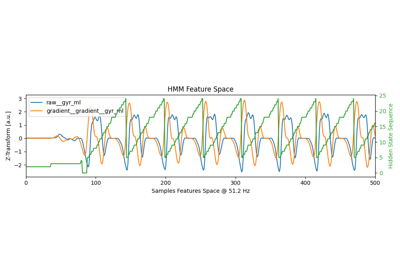
HMM stride segmentation - Prediction with pre-trained model